Made in China 2026: Why My Whole Apartment is Full of Chinese Tech and I’ve Completely Stopped Laughing
Take a moment to look around your room right now. What do you see? When I look around my own home, reality hits me square in the face.
An oversized TCL TV hangs on my wall. An MG ZS Hybrid is parked in the garage. Two electric scooters—a Nami and a Xiaomi—are parked in the hallway. In the kitchen, a Cosori air fryer is prepping dinner. In my workshop, two Bambu Lab (X1C and P1S) 3D printers are humming away, pumping out flawless prints at breakneck speeds. When I head out for a weekend trip, I pack a portable power station and a dual-zone fridge from Anker. And parked right next to my car is my full-suspension Crussis e-Full 12.11 e-MTB, powered by the revolutionary DJI Avinox M2S drive system.
Until recently, I even carried a flagship Vivo X200 Ultra in my pocket—a phone that was miles ahead of my current iPhone in terms of hardware and camera quality. I only switched back to Apple because their ecosystem holds me hostage and my whole family is locked into it. But there was simply no denying China’s massive technological lead.
Try telling me today, in 2026, that Chinese technology is cheap, low-quality junk.
You can’t. And believe me, just ten years ago, I would have agreed with you.
Why China Had a Bad Reputation—And Why It Was Well-Deserved
To understand where this myth came from, we have to go back twenty years. In the 1990s and early 2000s, China operated as the world’s cheap assembly line. Western corporations outsourced production there with a single goal in mind: cut costs to the absolute bone. Back then, China delivered exactly what the West ordered—extreme cheapness. The market was flooded with plastic toys that fell apart upon first touch and electronics that barely outlived their warranty.
But while the West was laughing at the cheap knock-offs, Chinese companies did something brilliant. They mastered the manufacturing processes, reverse-engineered the best designs, and poured every single dime of profit into their own R&D and headhunting global tech talent. They stopped being just factory workers. They became the engineers.
Coincidence? No, a Brutal Strategy Called „Made in China 2025“
In 2015, the Chinese government launched the „Made in China 2025„ initiative—an ambitious ten-year blueprint to transform their industry from a low-end assembly hub into a global tech leader. They targeted ten key sectors: electric vehicles, robotics, aerospace, semiconductors, and advanced IT. The West laughed it off at the time. Today, in 2026, nobody is laughing.
China now accounts for nearly 28% of global manufacturing output (almost $4.66 trillion annually). But the real shocker is the shift in export value. In 1995, garments and textiles made up 20% of Chinese exports, while electronics were below 9%. Today, high-tech electronics dominate a quarter of all exports, while textiles have shrunk to a minimum. China has successfully shifted from the world’s factory for cheap goods to the world’s factory for cutting-edge tech.
Case Studies: When Western Giants Fall to Their Knees
Let’s look at real-world market examples showing exactly how aggressively Chinese brands are dismantling established legacy competition.
1. Electric Vehicles: How China Left the World in the Dust
I drive an MG ZS Hybrid. For the price, there is simply no better car on the European market. Period. MG—a brand that originally belonged to a British motoring icon—is now owned by China’s SAIC Motor. And honestly? It’s a better, more reliable car than it ever was under British management.
And that’s just the tip of the iceberg. Chinese automakers are no longer playing second fiddle. Look at the skyrocketing global market share of Chinese brands in the EV and hybrid sector over the last five years:
| Year | Global Market Share of Chinese EV Manufacturers |
| 2021 | ~40% |
| 2022 | ~48% |
| 2023 | ~53% |
| 2024 | ~58% |
| 2025 / 2026 | Over 62% |
Europe panicked and responded by slapping additional tariffs of up to 35.3% on Chinese EVs. But that’s just an admission of their own weakness. Chinese cars are so well-engineered and vertically integrated that the European auto industry simply has no idea how to compete.
2. 3D Printers: How Bambu Lab Buried Josef Prusa’s Legacy in 3 Years
This one hurts as a European tech fan. Josef Prusa is a legendary figure in the industry—a Prague-based startup that became the global standard for 3D printing through open-source philosophy and rock-solid reliability.
Then came Bambu Lab. A Shenzhen-based company founded by former DJI engineers. In 2022, they launched the X1 Carbon. It brought a flawless, blazing-fast, multi-color „out of the box“ experience for a fraction of the cost. The result? Chinese brands (Bambu Lab, Creality, Elegoo, and Anycubic) now control 90.3% of the global consumer 3D printer market. The entire rest of the world is fighting over a measly 10%. Prusa wasn’t bad. China was just faster, more aggressive, and offered a vastly superior user experience.
3. Robot Vacuums: How EU Regulation Killed an American Pioneer
This story is incredibly frustrating. America’s iRobot essentially invented the entire robot vacuum category with the Roomba. When the Chinese wave started hitting them with technologically superior brands like Roborock or Dreame, Amazon stepped in with a $1.7 billion acquisition offer to save the company.
What did the European Commission and the US FTC do? They blocked the deal to „protect competition.“ Amazon walked away. The result? iRobot filed for bankruptcy, and at the turn of 2025/2026, it was completely bought out by a Chinese company, Shenzhen Picea Robotics. Western regulators successfully saved the market from Amazon, only to hand the entire Roomba brand, its patents, and the data maps of millions of Western homes to China on a silver platter.
4. Sony and TCL: The End of Japanese Dominance in Televisions
The TCL TV on my wall says it all. The traditional Japanese icon, Sony, could no longer compete with the pricing and rapid display-panel development of Chinese giants. The result? Sony signed an agreement where China’s TCL acquired a 51% majority stake in a new joint venture called BRAVIA Inc., taking full operational control of Sony’s TV and audio divisions. The TV might still say Sony on the bezel, but inside, it’s pure Chinese tech. Quite frankly, I expect a very similar fate for GoPro soon, as they are being utterly outclassed by DJI’s Action camera line.
5. Huawei and the „What If“ Scenario
Huawei was on a clear trajectory to become the number one smartphone manufacturer in the world. Their Mate and P series were pushing the boundaries of smartphone photography way past Samsung and Apple. The West had to step in politically—imposing sanctions and banning Google Mobile Services. Huawei was so good product-world-wise that it had to be eliminated administratively, not through fair market competition.
Avinox: When DJI Beats Bosch at Their Own Game
This brings me to my absolute favorite topic—e-bikes. For years, the premium e-bike market was safely ruled by traditional European and Japanese giants, with Germany’s Bosch leading the pack. Year after year, they incrementally improved their mid-drive motors by a few percentage points, tweaked their software, and charged premium prices for their ecosystem.
And then came DJI. The company that completely monopolized the global drone market looked at e-bikes and introduced the Avinox M2S system.
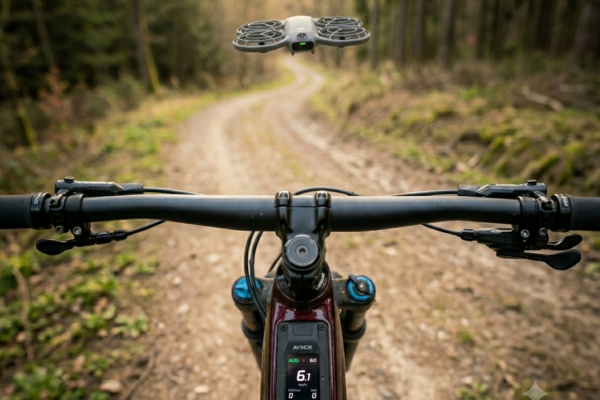
Boasting 1300W of peak power, 130 Nm of torque, a motor weight of just 2.59 kg, and GaN fast-charging that juices up an 800Wh battery to 75% in just an hour and a half, it was a freezing cold shower for European engineering teams. The entire ecosystem, complete with an integrated OLED display and live telemetry, works so flawlessly that Bosch has been forced into a defensive panic, rushing out updates and lighter weight concepts just to stay relevant.
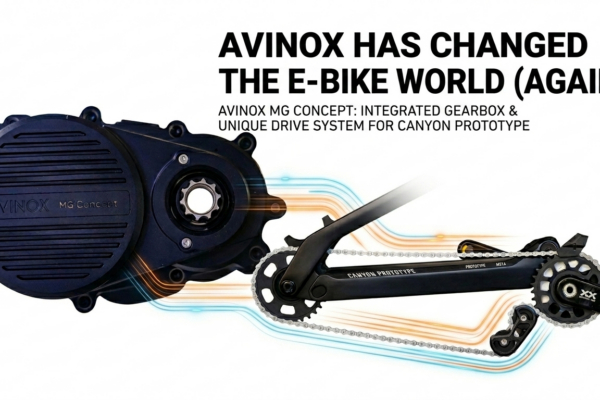
To rub salt into the wound, at the Eurobike 2026 trade show, DJI showcased their MG Concept—an e-bike motor with a fully integrated automatic gearbox inside the drive unit. Bosch has been making e-bike motors for over a decade. It took DJI just two years to turn them into a legacy brand playing catch-up.
Who is to Blame? The European Union or Chinese Drive?
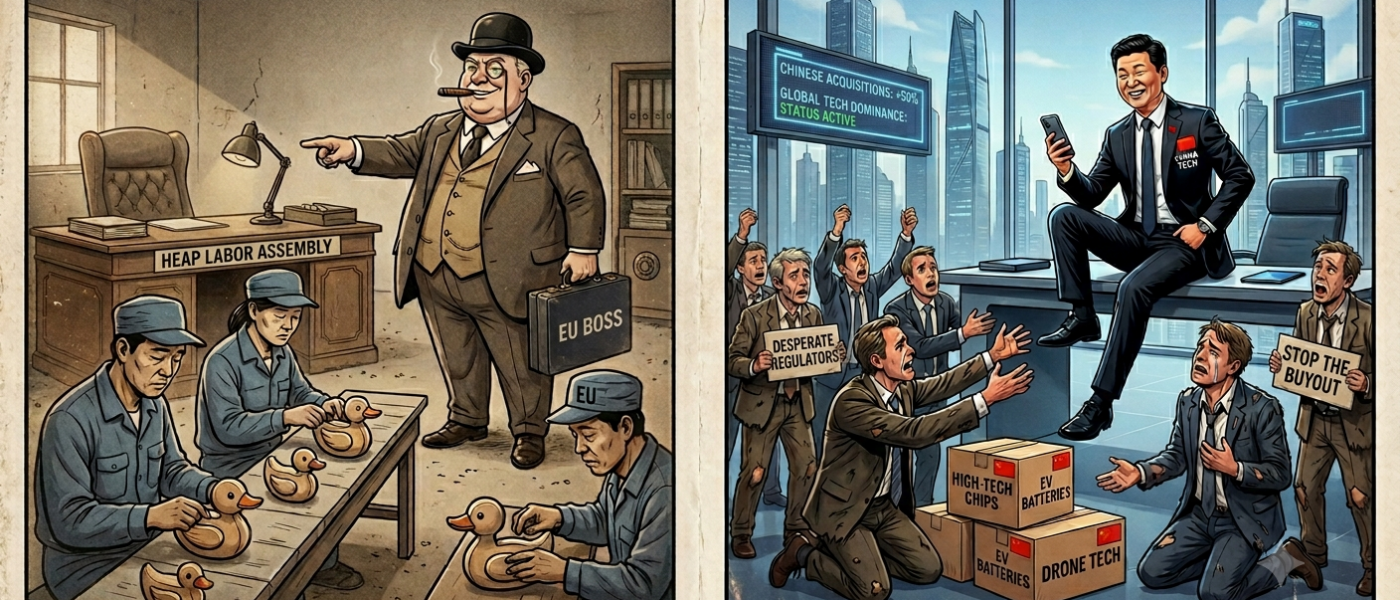
So, who is responsible for this shift? It is very easy to point fingers at the European Union, its over-regulation, bureaucracy, and policies that tie the hands of Western manufacturers while driving up production costs. Yes, the EU plays a part—it has turned Europe into a museum of paperwork while Asia innovates. The iRobot disaster is a perfect example of this.
But blaming it entirely on politics is a lazy excuse. Chinese companies are winning because of their brutal drive. Their R&D teams operate with relentless speed, their innovation cycles take months instead of years, and they control the entire vertical supply chain—from lithium mining to the final microchip. This isn’t unfair dumping; it’s hardcore capitalism in practice. The West simply grew complacent and fell asleep at the wheel.
The Verdict: Is It Good or Bad?
From a consumer perspective, it’s fantastic. We are getting our hands on technologies we couldn’t even dream of ten years ago. My MG is a great car at a fair price, my Bambu Lab prints flawlessly without tinkering, and the Avinox flies up any mountain trail with power to spare. China is forcing us to live in the technological future today.
But from a geopolitical and economic perspective, it’s a massive wake-up call. Europe and America are bleeding manufacturing know-how and becoming entirely dependent buyers. Unless Western companies drop the bureaucratic red tape, step up their pace, and start taking real risks again, we will soon look at a world where everything around us comes from one single country.
And we will keep buying it with a smile. Because it will simply be the best.