Charging or Extending? The Real Future of E-MTB Range
As the e-MTB market matures, we find ourselves at a crossroads regarding how to manage our range. Should manufacturers focus on developing bulky, heavy range extenders, or should they double down on fast-charging infrastructure?
Having spent significant time testing the Avinox system, I believe the answer is clearer than many think.
The Avinox Advantage
The current standard for many premium e-bikes involves adding an external battery to squeeze out more miles. However, looking at the Avinox system, this approach feels increasingly obsolete. With its 800 Wh battery capacity, the system is already substantial. But the real game-changer is the charging speed: the ability to hit an 80% charge in just 1.5 hours is a massive advantage.
When you compare the two options, the math doesn’t favor the extender:
- The Extender Dilemma: Carrying a range extender that adds roughly 250 Wh provides a relatively small boost in actual range while adding significant, constant weight to the frame.
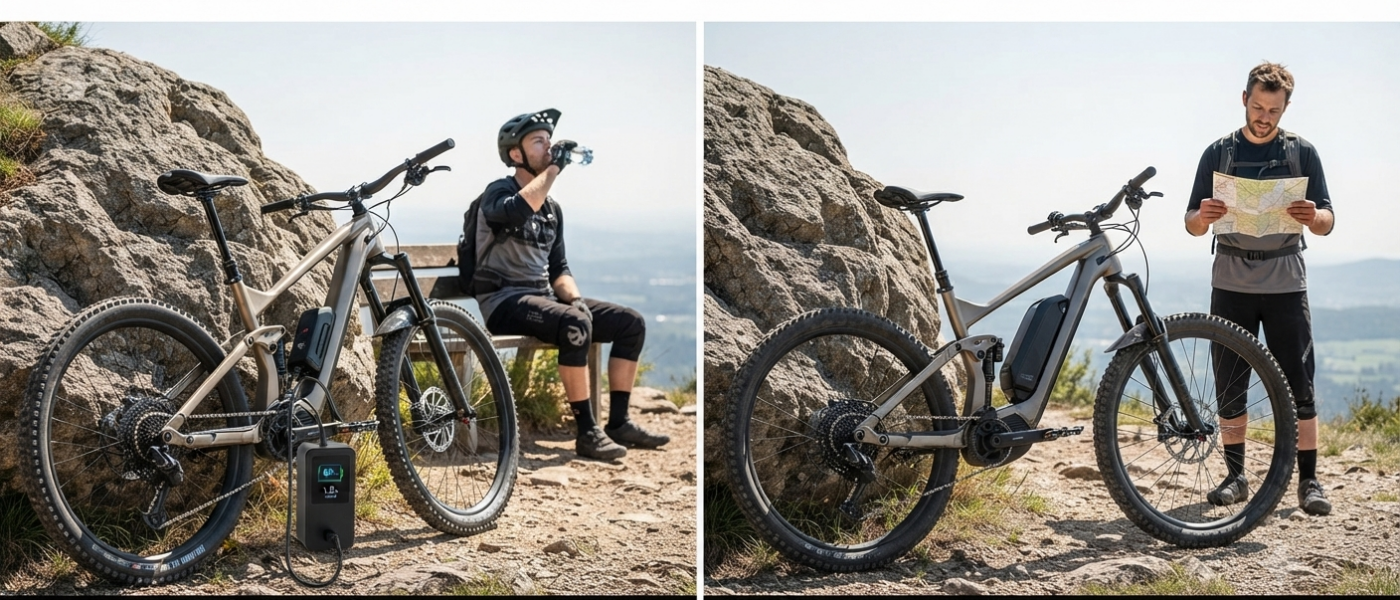
- The Charging Solution: Carrying a charger that weighs the same as an extender but allows you to replenish 80% of your primary, high-capacity battery is a far more efficient use of weight.
For riders who prioritize bike handling and agility, carrying extra weight on the frame—even if it’s an extender—diminishes the ride quality. If I can stop for a quick coffee break and gain 80% of my battery back, I’ve effectively „extended“ my day without ever having to compromise the bike’s design or weight distribution.
Why Competitors Still Need Extenders
The industry-wide obsession with range extenders is largely a symptom of limitations elsewhere. Take, for example, systems like the Bosch SX. These motors are designed for lightweight builds, but they are often paired with smaller internal batteries to keep the total system weight down.
Because manufacturers like Bosch currently lack a high-speed charging ecosystem comparable to what Avinox has achieved, they are forced to rely on range extenders to keep their bikes competitive for long-distance riders. Ironically, this creates a catch-22: by the time you mount a range extender to a „lightweight“ e-bike, you have completely negated the original advantage of the lighter platform.
The Verdict
The industry needs to stop treating range extenders as the only way to solve „range anxiety.“
While extenders have their place for specific edge cases, the future of the sport lies in power density and charging velocity. If manufacturers put the same engineering effort into ultra-fast charging technology that they currently put into cramming extra battery cells into external housings, we would see a massive leap in rider experience.
I’d much rather carry a fast charger in my pack than have a heavy, permanent weight penalty bolted to my downtube. For those of us who value performance and efficiency, the path forward isn’t about carrying more batteries—it’s about charging faster and smarter.
How do you think manufacturers should balance the trade-off between battery weight and charging speed for future e-bike models?